Best Coasters For Drinks: How To Choose The Right One For Every Drink And Table
A coaster that handles a hot coffee mug can fail under a sweating beer glass, and the set that looks right on the shelf often leaves a ring on the table. The fix is to match the material to the drink and the surface instead of buying three sets to find out. In this guide, we explain the best coasters for drinks by drink, table and setting.

Key Takeaways
- Pick by mechanism first: absorbent coasters (pulpboard, felt, cork, unglazed stone) suit cold, sweating drinks; wipe-clean materials (silicone, glazed ceramic, leather) suit spill-prone tables.
- Hot mugs need a slow conductor: ceramic, stone, cork and silicone slow heat transfer to the table; a thin paper coaster does almost nothing against heat.
- Any hard coaster needs a soft backing: unbacked stone, ceramic, metal and glass carry the highest scratch risk; cork-backed sets, felt and silicone the lowest.
- We supply high-quality custom coasters in various styles and materials, with a free proof and generous bulk discounts.
Table of contents
-
What Are The Best Coasters For Drinks?
-
Which Coaster Materials Perform Best For Different Drinks And Uses?
-
Which Coasters Are Best For Condensation And Water Rings?
-
Which Coasters Are Best For Hot Drinks And Heat Protection?
-
How Do Coasters Protect Tabletops And Furniture?
-
Which Coasters Offer The Best Combination Of Durability And Everyday Performance?
-
Which Coasters Are Easiest To Clean And Maintain?
-
Which Coasters Work Best For Different Types Of Businesses?
What Are The Best Coasters For Drinks?
The best coaster for a drink is the one whose material matches the drink's problem: an absorbent coaster for a cold, sweating glass, a heat-slowing coaster such as ceramic, stone or silicone for a hot mug, and a disposable pulpboard coaster where volume and branding matter more than reuse.
Good coasters protect the surface, stay put under the glass, handle condensation or heat without passing it to the table, and suit your cleaning routine.
Settle three questions before comparing materials: which drinks land on it most, what the table is made of, and whether you'll wipe, wash or replace it.
What to evaluate now is that same list, not a product of the year. We print and cut coasters in every material on this page, and the returns and reorders tell us which ones fail and how. For the basics, our guide to what coasters are made of sorts the options by job.
Which Coaster Materials Perform Best For Different Drinks And Uses?
Pick by mechanism first: absorb (pulpboard, paper, wool felt, cork, unglazed stone) for cold drinks, contain or shed (silicone, glazed ceramic, sealed wood, leather) for spill-prone tables, and a thick, low-conductivity material (ceramic, stone, cork, silicone) under hot mugs. Then pick the material within that group by cleaning and look.
Material decides absorbency, heat behavior, cleaning, durability, weight and appearance at once, and the table shows where each one gives way.
| Material | Condensation (mechanism) | Hot mug | Cleaning | How it fails | Pick it for |
|---|---|---|---|---|---|
| Pulpboard (3 to 5 mm) | Absorbs, then saturates | Mug only, not a pot | Replace | Single use by design; softens when soaked | Bars, breweries, events; cold drinks at volume |
| Paper board (1 to 2 mm) | Absorbs, saturates fast | Mug only | Replace | Soaks through in one sweaty pint | Short events, giveaways |
| Wool felt | Absorbs, holds a lot | Mug only | Wash and air-dry | Pills; holds odor if left wet | Home sets; cold drinks on wood |
| Cork | Absorbs some; resists but not waterproof | Yes | Wipe, then dry | Edges crumble over years; red wine stains | Hot mugs at home; backing for hard coasters |
| Sandstone or diatomite (unglazed) | Absorbs, then saturates | Yes | Wipe, air-dry | Coffee and wine stain it; chips when dropped | Sweating glasses on a stone or glass table |
| Glazed ceramic or porcelain | Sheds; water sits on top | Yes | Wipe | Chips; backing peels | Hot drinks; spills; wipe-clean venues |
| Slate | Sheds unless unsealed | Yes | Wipe | Flakes at edges; scratches tables if unbacked | Hot mugs; engraved sets |
| Marble | Sheds when polished; absorbs when honed | Yes | Wipe, dry | Etches with acid; heavy | Hot drinks; decor; needs backing |
| Wood | Contains if recessed; finish-dependent | Finish can blush or mark | Wipe, dry | Rings if unsealed; finish wears | Dry drinks; rustic bars; recessed designs |
| Leather | Sheds; water-spots unless sealed | Mug only | Wipe | Spots and stiffens if soaked | Whiskey and wine; low-maintenance decor |
| Silicone | Contains with a lip; sheds flat | Yes | Wipe or wash | Attracts dust; otherwise lasts | Kids, patios, spill-prone tables |
| Metal | Sheds | Conducts heat to the table | Wipe | Scratches tables; conducts heat | Trays and lipped designs only, with backing |
Categories overlap the mechanisms: natural (cork, wood, stone, leather, wool), manufactured (ceramic, silicone, metal), disposable (paper, pulpboard), and recyclable, compostable or upcycled (uncoated board, cork, reclaimed wood).
How Does Coaster Material Affect Performance?
Material sets how water and heat move through the coaster, which is what the table feels. Condensation either sinks into the coaster, pools on it, or runs off the edge, and the last two reach the table unless a lip stops them.
With a hot mug, a dense slow conductor such as ceramic or stone takes the heat gradually, while a thin board passes it straight through.
Work with us to print custom pulpboard coasters for high-volume service, with a free proof before you pay.
Need absorbent coasters that keep up with a busy bar?
Work with us to print custom pulpboard coasters in 3, 4 or 5 mm, front or both sides, with a free proof before you pay and generous bulk discounts.
Which Coasters Are Best For Condensation And Water Rings?
For condensation, choose a coaster that absorbs (pulpboard, paper, wool felt, cork, unglazed stone) or contains (silicone with a lip, recessed wood), because a flat non-absorbent coaster lets the water run off its edge onto the table.
A cold glass sweats because water vapor cools against it, and the USGS Water Science School's page on condensation notes that people buy coasters to keep that condensed water from dripping.
No coaster stops a glass from sweating. It decides where the water goes:
- Deep absorption: board, felt and unglazed stone pull the water inside, until they saturate.
- Surface containment: a lip or a recess holds the water until someone empties it.
- Evaporation: a flat shedding coaster waits for the room to dry the water, which fails on humid nights.
With chilled cocktails, beer and iced drinks, absorbent beats shedding. Our coasters for sweaty drinks guide goes deeper.
What Are The Most Absorbent Drink Coasters?
The most absorbent drink coasters are wool felt, unglazed sandstone or diatomite, pulpboard and paper board:
- Pulpboard takes water fast and holds more because it's thicker; it's built to be replaced.
- Wool felt holds the most for its weight. The American Sheep Industry Association's wool fact sheet states wool can absorb up to 30% of its weight in moisture without feeling damp.
- Unglazed stone wicks fast but stains with coffee and wine.
- Cork absorbs slowly and less. It resists water but is not waterproof.
Saturation is the catch: a soaked felt or stone coaster has a damp underside, and that underside sits on the table. Our rule: absorbent and reusable must dry; absorbent and disposable gets replaced; non-absorbent gets wiped. Polished marble sheds, as our guide on whether marble coasters absorb water explains.
At home, custom felt coasters hold the most water per piece.
Choose felt coasters for a reusable home set
Our custom felt coasters soak up condensation from cold drinks and carry names, dates or a monogram, in various styles at competitive prices.
Learn moreWhich Coasters Are Best For Hot Drinks And Heat Protection?
For hot drinks, choose a coaster that slows heat transfer: ceramic, stone, marble, sandstone, slate, cork or silicone.
Coffee arrives hot: a 2019 review in the Journal of Food Science notes it is often brewed at 200 °F (93 °C) and gives 130 to 160 °F as an appropriate service range. A mug that is hot, left in one spot, can soften or cloud some finishes. No coaster makes a table heat-proof, but a slow conductor buys time.
Cork earns its place here. A 2015 review in Frontiers in Materials gives it a thermal conductivity of 0.045 W/m·K and a density of 0.24 g/cm³. That is why a cork layer under stone or ceramic does most of the insulating. The trade-off: heavy coasters chip when dropped and need a soft backing.
What Are The Best Coasters For Hot Drinks?
For coffee, tea and hot chocolate, a cork-backed ceramic or stone coaster is the pick for a wood or finished table, and plain cork or silicone where weight or a patio matters.
Ranked by what they do to the table:
- Glazed ceramic with cork backing: slows heat, wipes clean; chips if dropped.
- Stone, slate or marble with cork backing: slows heat; heavy, and marble etches with acid.
- Cork alone: light and insulating; can't take a pot.
- Silicone: tolerates a hot mug; check the product's own rating before anything hotter.
Favor a flat, 4 inch or wider piece for a wide mug base. Work with us to create custom ceramic coasters printed with a logo or a photo for hot mugs at the counter.
How Do Coasters Protect Tabletops And Furniture?
A coaster protects a table by putting a barrier between the glass and the finish against moisture, heat, scratches, stains and spills.
Each surface has its own weak point. Wood and finished surfaces take water rings and heat blush, stone countertops absorb colored spills and can etch, and glass scratches under grit.
Construction decides it:
- Underside: a soft layer (cork, felt, rubber) keeps grit and hard edges off the finish.
- Edge: a lip or a recess contains a spill; a flat edge sheds it.
- Flatness: a coaster that lies flat and stays put protects; one that slides or rocks doesn't.
A folded napkin or a saucer is a stopgap: one soaks the table, the other holds the puddle.
If the table is wood, our guide to the best coasters for a wood table walks through it finish by finish.
What Role Does Cork Backing Play In Surface Protection?
Cork backing is the soft barrier between a hard coaster and the table: it keeps the hard face off the finish, it grips so the coaster doesn't slide, and it keeps a saturated coaster's damp underside off the wood.
On any table and with any hard coaster, backed versus unbacked is a bigger decision than which stone you choose. We've seen unbacked stone sets come back with the table's finish on the underside, and the cork-backed ones don't.
Cork is not a guarantee. Grit trapped in it can still mark a soft finish, so wipe the underside now and then. Work with us to print personalized stone coasters with names, dates, logos or QR codes, and check the backing spec on the product page before you order.
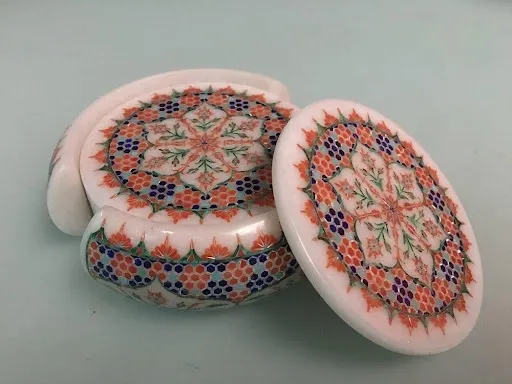
Looking for stone coasters that slow heat under a hot mug?
Create personalized stone coasters that put a slow conductor between the mug and the table, printed with your artwork for gifts or venues.
Which Coasters Offer The Best Combination Of Durability And Everyday Performance?
The durable picks for everyday use are silicone, glazed ceramic with a sound backing, and sealed wood, with felt and cork close behind if someone dries them.
Every material has a failure mode, and that is what to buy against:
- Felt: pills, compresses and holds odor if it stays wet.
- Cork: crumbles at the edge after years; stains with red wine.
- Wood: finish wears, and it rings if the finish fails.
- Ceramic and stone: chip when dropped; backing peels.
- Leather: water-spots and stiffens unless sealed.
- Silicone: attracts dust; otherwise it keeps going.
- Metal: scratches tables and passes heat straight through.
Value is the price divided by the drinks it survives, not the price on the box.
What Makes A Drink Coaster Durable?
Durable drink coasters share even thickness, a secure backing, finished edges, and a material that tolerates its own cleaning routine.
Soft absorbent coasters wear by saturating and drying again and again, so thickness and a tight board or fiber matter. Hard coasters wear at the edges and the glue line, so a rounded edge and a full backing last longer.
Frequent cleaning is its own wear: felt washed weekly thins faster than felt air-dried, and a dishwasher can lift a backing.
Need branded bar coasters in bulk for your venue?
Order custom bar coasters in bulk with your logo, menu or QR code, in the material that suits your drinks, with fast turnaround times and wholesale pricing.
Get startedWhich Coasters Are Easiest To Clean And Maintain?
The easiest coasters to clean are the wipe-clean ones: silicone, glazed ceramic, sealed wood, leather and metal.
Cleaning splits into three routines. Wipe the shedding materials after each use, and wash and air-dry felt, cork and fabric, flat, never putting them away damp.
Replace paper and pulpboard, which aren't meant to be cleaned.
Damp is the enemy of the absorbent group. North Dakota State University's home-moisture guide on mold ecology states that mold grows on organic materials and that above about 70 percent relative humidity there is enough moisture for it to grow. A felt coaster left wet in a stack sits well above that.
We've found the material that fails first in a bar is the one nobody dries, rather than the one that absorbs least.
Which Coasters Are Best For Low-Maintenance Use?
Low-maintenance use calls for silicone, glazed ceramic, sealed wood, leather or metal, because each wipes clean in seconds and none has to dry overnight.
Silicone or glazed ceramic takes a damp cloth and is back on the table, while felt needs hours on a rack. Leather and sealed wood want a dry wipe and no soaking.
Low-maintenance beats deep absorption when the table wipes clean, when drinks are mostly hot, or when nobody will dry the coasters. It loses when drinks sweat hard on a wood table, where you want the water inside the coaster.
Which Coasters Work Best For Different Types Of Businesses?
A business should pick the coaster by volume, drink mix, cleaning routine and branding: disposable printed pulpboard for high-volume bars and breweries, and a backed reusable set where presentation outranks turnover. A household set is 4 to 12 pieces. A bar, a wedding or a corporate event is a 50-piece job, which is our minimum order.
| Venue | Volume | Drink mix | Pick | Why | Format |
|---|---|---|---|---|---|
| Bar | High | Cold beer, cocktails, sweating glasses | Printed pulpboard, 4 mm | Absorbs a pint's condensation; fresh branding every round | Disposable |
| Brewery or taproom | High | Pints and flights | Printed pulpboard or paper board | Low cost per pour; doubles as a takeaway | Disposable |
| Restaurant | Medium | Wine, water, cocktails | Glazed ceramic or silicone with backing | Wipes between covers; sits well on linen or wood | Reusable |
| Cafe | Medium | Hot mugs, iced coffee | Cork or cork-backed ceramic | Slows heat; wipes clean | Reusable |
| Hotel lounge | Low to medium | Spirits, wine, coffee | Cork-backed stone or leather | Presentation and table protection | Reusable |
| Corporate event | One-off | Mixed | Printed pulpboard or a printed cork set | Branding at volume; the set doubles as a gift | Disposable or gift |
Cost per use is the honest comparison: a reusable coaster's cost per use is its unit price divided by the services it survives before replacement, while a disposable pulpboard coaster's cost per use is its unit price. If a reusable coaster costs ten times a disposable one and survives 200 services, its cost per use is a twentieth of the disposable's.
Don't look for a ranking of coaster makers; judge any on material options, print method, minimum order, proof policy and remake policy. Custom Coasters Now (customcoastersnow.com) prints custom coasters to order in pulpboard, cork, felt, ceramic, stone, wood and more, with a minimum order of 50 and a free proof before you pay through the "See Design - Pay later" option.
Why Are Paper Coasters Common In Bars And Events?
Paper and pulpboard coasters are common in bars and events because they absorb, cost little per unit, carry a printed message and get thrown away.
Kohlschein's coaster-board data sheet describes a pure woodpulp board with uncoated surfaces and good moisture absorption, listed at 390 g/m² for 0.9 mm and 580 g/m² for 1.4 mm. Our pulpboard runs thicker, at 3, 4 or 5 mm, and prints on one or both sides.
The reorders we see most are pulpboard, because a fresh printed coaster in front of every guest is the point, not a flaw. Work with us to print custom bar coasters in bulk with a logo or QR code and generous bulk discounts.
Frequently Asked Questions About 'Best Coasters For Drinks'
What Type Of Coaster Is Best For Drinks?
The best coaster for a drink matches the drink's problem: an absorbent coaster (pulpboard, felt, cork, unglazed stone) for a cold, sweating glass, a heat-slowing coaster (ceramic, stone, silicone) for a hot mug, and disposable pulpboard where volume and branding matter.
Which Coaster Materials Work Best For Different Drinks And Uses?
Pulpboard and paper suit bars and events; wool felt and unglazed stone suit sweating drinks at home; cork-backed ceramic or stone suits hot mugs on wood; silicone and glazed ceramic suit spill-prone, wipe-clean tables. Back every hard coaster with cork.