Quilted Wine Glass Coaster Pattern: How Can You Sew A Practical And Decorative Set?
A quilted wine glass coaster is a small padded fabric "slipper" that fits around the foot of a stemmed glass. A useful pattern must solve two problems: the opening must fit the glass base, and the finished piece must stay flat. In this guide, we walk the quilted wine glass coaster pattern through fabric, sizing and construction.
Key Takeaways
- Measure the widest part of the wine-glass foot before choosing or resizing a pattern; a 4.5 to 5-inch finished coaster is a craft convention, not an official standard.
- The seam allowance stated by the pattern controls the finished size. Quilted coasters typically use 1/4 inch, not the 5/8 inch garment default.
- Tightly woven cotton is easy to sew and practical for washable sets. Prewashing washable fabric reduces surprises from dimensional change.
- We supply high-quality custom fabric, felt and embroidered cotton and linen coasters, with a free proof and a 50-piece minimum for weddings, wine clubs and tastings.
Table of contents
-
What Is A Quilted Wine Glass Coaster Pattern?
-
Where Can You Find A Free Wine Glass Coaster Pattern?
-
What Materials Do You Need To Sew Wine Glass Coasters?
-
How Do You Make Wine Glass Coasters From A Pattern?
-
How Do You Quilt And Finish A Wine Glass Coaster?
-
What Size Should A Quilted Wine Glass Coaster Be?
-
Which Wine Coaster Pattern Style Should You Choose?
-
How Can You Customize A Quilted Wine Glass Coaster Pattern?
What Is A Quilted Wine Glass Coaster Pattern?
A quilted wine glass coaster pattern provides the shape, measurements and construction order for a small fabric coaster that surrounds the base of a stemmed glass. "Wine glass slipper" is another common craft term for the fitted style.
Most versions use overlapping folded sections to create an opening. The glass foot slides under those sections, while a padded lower layer sits beneath the glass. You need fabric, batting, thread, a sewing machine, scissors or a rotary cutter, pins or clips, an iron and the chosen template. An experienced beginner who can sew an even seam, turn a small project and press accurately can handle a simple folded style.
Where Can You Find A Free Wine Glass Coaster Pattern?
Free patterns appear on sewing blogs, quilting websites and designer pattern libraries. A useful one should give a printable template or dimensions, the seam allowance, the finished size and complete construction instructions.
Paid downloads may add multiple sizes, cleaner printable layouts, diagrams or designer support. Price alone does not tell you whether the pattern is better. Print a test page at 100% or "actual size" and measure any calibration square before cutting fabric. "Fit to page" can change the dimensions. Check the designer's stated usage terms before distributing the pattern file or using its artwork commercially. The US Copyright Office's Circular 33 says a simple set of directions is uncopyrightable and that copyright excludes methods, so a pattern's technique is not protected while its written text and photos are.
How Should You Choose A Wine Glass Coaster Sewing Pattern?
Start with the finished dimensions and opening, not the photograph. Confirm that your glass foot can enter the opening without forcing the seams.
Next, check the seam allowance and construction family. A folded four-section slipper is relatively simple. A woven or multi-piece style needs more careful ordering and usually more cutting. Project photographs can help you judge whether the opening stays centered and whether the finished coaster lies flat, but measurements should make the final decision. Our easy quilted coasters guide covers the flat quilted style if a slipper isn't quite right for your table.
Want wine glass coasters without the sewing calendar?
Work with us to make fabric coasters printed with your design, ready to wrap wine tables and tastings without a template or a rotary cutter.
What Materials Do You Need To Sew Wine Glass Coasters?
For a basic set, use tightly woven fabric, thin batting, all-purpose sewing thread, scissors or a rotary cutter, pins or clips and an iron.
Cotton batting gives modest structure without a large amount of bulk. Thick fleece can make the overlapping opening harder to turn neatly. Pressing tools matter on a project this small because every folded edge changes the opening. A seam gauge or small ruler helps keep repeated folds and seams consistent. For batch sewing, cut all pieces from one tested pattern before moving to assembly. On the event tables we supply, we've measured many wine-glass feet; most standard stemware falls between 2.5 and 3.25 inches across.
What Fabric And Batting Work Best For Quilted Wine Coasters?
Tightly woven cotton is a useful default because it handles predictably during cutting, pressing and laundering. Linen can produce a more textured look but may shift more while sewing. Felt does not fray but adds bulk. Synthetic fabrics vary widely, so use their own care and pressing instructions.
Textile research confirms that fiber choice changes water interaction. Cotton binds substantially more moisture than polyester under controlled humidity conditions, although that does not by itself prove one finished coaster is "more absorbent" because weave, batting and construction also matter.
Prewash washable cotton when you want the finished set to go through normal laundering. Research on laundering and dimensional stability of woven cotton measured dimensional changes, skew and wrinkling in plain woven cotton under home-laundering conditions. The study does not prescribe a coaster wash routine, but it supports treating dimensional change as a real fabric property rather than assuming an unwashed cut piece will remain identical after laundering. We've found a 5 inch cut square is the one number sewists agree on, and a scant quarter-inch seam is the one they get wrong.
Choose embroidered cotton coasters for tastings and events
Our cotton and linen embroidered coasters deliver the handmade feel of quilted stemware with professional stitching precision.
Learn moreHow Do You Make Wine Glass Coasters From A Pattern?
Use the pattern's own cut size and seam allowance. Do not substitute the 5/8-inch garment allowance you may know from dressmaking.
- Print the pattern at 100% and verify its scale.
- Measure the glass foot and compare it with the stated opening.
- Prewash and press fabric if the finished coaster will be routinely washed.
- Cut the top, folded sections and batting according to the chosen construction.
- Fold and press the overlapping pieces before layering.
- Layer the sections in the order shown by the pattern so they create a centered opening.
- Stitch around the outer edge using the pattern's seam allowance.
- Trim excess bulk, turn the piece, press it square and topstitch or quilt as required.
- Test the glass foot through the opening before cutting the rest of the batch.
We've seen slippers fail at a tasting because they were cut from a template printed at "fit to page"; the opening came out 3/8 inch small and nothing sat flat.
How Should You Layer And Sew The Wine Glass Coaster Pieces?
In a folded slipper, the overlapping top sections must meet evenly enough to create the opening without leaving a bulky ridge under the glass. Keep their raw outer edges aligned with the backing before stitching.
Maintain the same seam allowance around the piece. Even a small variation matters on a project only a few inches wide. University of Kentucky Cooperative Extension defines the seam allowance as the distance from the stitching line to the cut edge and notes 5/8 inch as the default for many garment seams unless a pattern says otherwise. Small quilted projects often specify a narrower allowance, which is why the number printed on the coaster pattern must win. Before turning, trim bulky corners only where the pattern permits. Turn gently so the opening and outer corners are not stretched out of shape.
How Do You Quilt And Finish A Wine Glass Coaster?
Quilting keeps the batting and fabric from behaving as separate layers. Straight lines are the easiest to repeat, while diagonals, crosshatching or a small motif can add decoration.
Avoid dense stitching immediately beside the glass opening if it makes that area rigid or bulky. Topstitching close to the outer edge can sharpen the shape after turning and reinforce the perimeter. Press before topstitching so the seam sits where you want it rather than being forced flat by the needle. Our fabric coasters ideas guide covers quilting motifs and embellishment options for coordinated sets.
How Can You Keep A Quilted Wine Coaster Flat And Neat?
Control the fabric rather than pulling it through the machine. Keep the layers aligned, use consistent stitch length, and make sure thread tension suits the fabric.
Research on sewing tension and seam puckering found that fabric behavior, sewing-thread properties, thread tension and laundering can affect seam puckering. The experiment used woven apparel fabrics rather than quilted coasters, but the mechanism is useful for troubleshooting a coaster that ripples along a sewn edge. If the coaster puckers, test machine tension and stitch length on layered scraps before altering the pattern. Trim excess bulk before turning, then press rather than stretching the finished piece.
Need wine coasters in bulk for a wedding or wine club?
Order custom coasters in bulk with your monogram, wedding date or club logo, at generous wholesale discounts.
What Size Should A Quilted Wine Glass Coaster Be?
A flat quilted coaster often finishes somewhere around 4.5 to 5 inches, but a fitted wine-glass coaster has another dimension that matters more: its opening must accommodate the foot of the actual glass.
Measure the widest part of the glass foot. As practical sizing guidance, allow roughly 1/4 to 1/2 inch of total ease in the opening so the base can slide in without the slipper hanging loose.
| Glass-foot diameter | Starting opening target | Suggested test approach |
|---|---|---|
| 2.5 in | About 2.75 to 3 in | Test one before batch cutting |
| 2.75 in | About 3 to 3.25 in | Check that folded sections still overlap securely |
| 3 in | About 3.25 to 3.5 in | Use a larger template if the original opening is tight |
| 3.25 in | About 3.5 to 3.75 in | Confirm overall coaster width still supports the base |
These are sizing calculations, not industry standards. Pattern geometry changes how a cut square converts into an opening, so make one sample before applying the table to a particular template.
How Can You Resize A Wine Glass Coaster Sewing Pattern?
If the entire pattern needs scaling, change all dimensions proportionally rather than widening only one side. Print the altered template and remeasure both the outer size and opening.
If a pattern contains a calibration square, verify that before cutting fabric. Do not assume that setting a printer to "fit" or "shrink oversized pages" preserves the intended size. Use 100% or actual-size printing unless the designer tells you otherwise. After resizing, sew one test coaster. Fabric, batting and seam width all affect the final fit.
Print any design onto durable felt coasters
Felt coasters carry a soft, tactile feel similar to quilted fabric, and we print your patterns with a free proof before you pay.
Get startedWhich Wine Coaster Pattern Style Should You Choose?
Choose the style according to fit, sewing experience and how the coaster will be used. A fitted slipper moves with a stemmed glass. A flat coaster is simpler when the glass is stemless or when the user does not need the coaster attached.
Folded-fabric slippers are beginner-friendly and fast to assemble. Woven or multi-piece slippers give a more decorative opening at the cost of extra cutting. Flower-shaped fitted coasters carry a stronger decorative theme. Flat quilted coasters skip the fitted opening entirely and suit stemless glasses. Charm-style pieces exist for identification only and do not protect the table. Different fabrics and quilting details create coordinated sets for weddings, wine tastings and gifts, and our custom personalized wine bottle coasters match sets for the bottles that sit alongside the glasses.
Can A Wine Glass Slipper Pattern Be Used As A Wine Charm?
Yes. Use different fabrics, initials, embroidery or small appliqués so guests can distinguish their glasses.
Keep identifying details light and away from the central opening. A thick embellishment under the foot can make the glass wobble. This dual function is especially useful for tastings, receptions and dinners where several similar glasses are in use at once. Our custom fabric coasters print monograms or event branding on flat coasters for the same purpose.
How Can You Customize A Quilted Wine Glass Coaster Pattern?
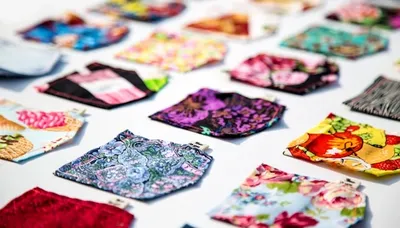
Change fabric combinations and quilting before changing the underlying fit. A set can look coordinated even when each coaster uses a different print if the same backing, border color or stitch motif repeats.
Holiday fabrics, wedding colors, wine-club motifs and monograms all fit the format. For a large event, make one complete sample, wash it as the finished pieces will be washed, and retest it on the glass before batch-cutting the rest. The Canadian Conservation Institute's textile guidance notes that heat and humidity can degrade textiles quickly at high RH, so dry finished coasters fully before storing.
For a large wedding, wine-club or corporate set, a batch decision matters. A charm pack of 42 five-inch squares yields about seven six-square slippers. One yard of 44-inch quilting cotton cuts roughly 56 five-inch squares, or about nine coasters. Cotton batting adds a square per coaster. Budget the fabric before cutting.
How Can You Add Decorative Details To Wine Glass Coasters?
Use lightweight appliqués, initials, embroidery, felt shapes or contrasting fabric where they will not obstruct the opening.
Secure each embellishment for the expected washing method. Avoid beads or thick trims under the glass base because they can make the glass wobble. A repeated detail can also identify glasses at a shared table. Six coasters using the same construction but six different embroidered initials still read as one set. Custom Coasters Now (customcoastersnow.com) makes fabric, felt and embroidered cotton and linen coasters at a 50-piece minimum with a free proof, so a large event set is a real alternative when the count grows past what a weekend of sewing can cover.
Frequently Asked Questions About Quilted Wine Glass Coaster Pattern
What Is A Wine Glass Coaster Pattern?
A wine glass coaster pattern provides the dimensions and construction sequence for a small fabric coaster designed to sit under or fit around a wine-glass base. A fitted "slipper" pattern usually uses overlapping fabric sections to create an opening that holds the glass foot.
Where Can You Find A Free Pattern For A Wine Glass Coaster?
Free patterns are available from quilting websites, sewing blogs and designer pattern libraries. Choose one that states the finished size, seam allowance, print scale, required materials and complete construction steps. Then check the designer's stated usage terms before printing.