Best Coasters For Wood Table: Which Ones Protect Your Furniture Best?
A wood table takes damage from three directions: the water ring under a cold glass, the cloudy heat mark under a hot mug, and the fine scratch from a coaster that should have helped. The fix is the right construction, not the material name. This article is our look into the best coasters for wood table protection and how to pick one set.

Key Takeaways
- Pick by construction, not material name: a soft underside (cork, felt or leather), a surface wider than the glass base, and a plan for condensation.
- Water reaches a finish by three paths: a saturated underside, run-off over an undersized edge, or drips beside the coaster.
- A coaster slows heat, it does not block it: use a thick, low-conductivity coaster for mugs and a trivet for cookware.
- We supply high-quality custom coasters in cork, felt, leather, silicone, wood, ceramic, slate and marble, personalized with names, logos or artwork.
Table of contents
-
What Are The Best Coasters For Wood Tables?
-
Which Coaster Materials Are Commonly Used For Wood Tables?
-
What Are Some Good Coasters That Won't Scratch A Wood Table?
-
What Is The Best Absorbent Material For Coasters?
-
What Is The Best Waterproof Material For Coasters?
-
What Is The Best Coaster Material For Hot Drinks?
-
How Do You Choose The Best Coaster Size And Shape For A Wood Table?
-
How Do You Choose Durable Coasters For Long-Term Use?
What Are The Best Coasters For Wood Tables?
The best coasters for a wood table have a soft underside (cork, felt or leather), enough surface to catch a sweating glass, and either absorb condensation (then dry between uses) or contain it behind a lip. That way neither water nor heat reaches the finish.
Check four things:
- Underside. Soft, clean and flat. A bare stone, ceramic, metal or glass base is the one thing we rule out for wood.
- Moisture plan. Absorbent coasters take water in and need to dry. Non-absorbent ones need a lip or a margin.
- Heat buffer. For hot mugs, thickness and a slow-conducting material beat a "heat-resistant" label.
- Coverage. Widest glass base plus about 1 inch, so a wet ring lands on the coaster, not beside it.
For cold drinks on wood, the common-case pick is a cork-backed absorbent coaster or a felt coaster that you let dry. For hot mugs, a cork-backed ceramic or stone coaster, or a silicone one.
White rings are usually clouding in the finish film, not the wood. Our custom cork coasters are the simplest version of that rule.
Which Coaster Materials Are Commonly Used For Wood Tables?
Cork, wool felt, leather, silicone, wood, ceramic, slate and marble are the eight common choices for a wood table. Each one is a different construction as much as a different look.
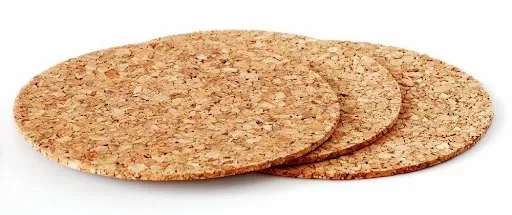
Cork is compressible bark, sold plain or as backing under harder coasters. Felt is pressed fiber, leather a dyed hide, silicone a molded rubber.
Wood is a finished slab, often paired with cork. Ceramic is fired clay, glazed on top and bisque (unglazed) or cork-backed underneath. Slate and marble are cut stone with feet or a pad.
The complete coaster matters more than the headline material, because the underside and the finish are what the table feels. Our guide to what coasters are made of sorts each one by job.
What Are The Main Coaster Materials And Their Basic Characteristics?
The main coaster materials differ in weight, softness, maintenance, surface finish and appearance. How each performs under a drink comes later.
| Material | Weight | Underside | Care | Look | Material |
|---|---|---|---|---|---|
| Cork | Light | Soft | Wipe, dry | Warm, casual | Cork |
| Wool felt | Light | Soft | Wash, air-dry | Soft, modern | Wool felt |
| Leather | Light–medium | Soft to firm | Wipe | Rich, traditional | Leather |
| Silicone | Light | Grippy | Wipe or wash | Utilitarian | Silicone |
| Wood | Medium | Needs pad | Wipe, dry | Matches table | Wood |
| Ceramic | Medium–heavy | Needs pad | Wipe | Decorative | Ceramic |
| Slate | Heavy | Needs feet | Wipe | Dark, rustic | Slate |
| Marble | Heavy | Needs pad | Wipe, dry fast | Formal, cool | Marble |
Wood or cork? Wood for looks and stability, cork for the underside and for heat, so a wood-and-cork coaster is the honest answer for most tables.
Why are wooden coasters rough? Unsanded end grain, or grain raised by the first wet glass. The smoothest we've handled are closed-grain maple or cherry, sanded to 220 grit and finished on every face, as our woodworking coasters guide explains.
Need coasters that are gentle on a wood table?
Work with us to create custom cork coasters with a soft underside, personalized with names, logos or artwork, with a free proof before you pay.
What Are Some Good Coasters That Won't Scratch A Wood Table?
Good coasters that won't scratch a wood table have a clean, soft underside (cork, felt, leather or silicone), smooth rounded edges, and a flat, stable build. No coaster is scratch-proof, so the aim is to reduce the risk.
Scratch risk is two things: underside hardness plus trapped grit. A hard stone base does little while it rests still. Dragged over a grain of sand it does the damage, because quartz sits at 7 on the Mohs scale, harder than window glass at 5.5.
Per the National Park Service's Conserve O Gram on dusting wood objects, hard, sharp siliceous particles cause abrasion and are likely to scratch highly polished surfaces.
So wipe the table, lift rather than slide, and check the underside for dried sugar or peeling backing. We've found that the hard coasters that leave a mark have exposed stone, metal or glass underneath, or a cork pad worn through at the edge. Soft all-through custom felt coasters remove the hardness half of the equation.
What Role Does Cork Backing Play In Surface Protection?
Cork backing creates separation: a soft layer between a hard coaster and the finish, so the stone or ceramic never touches the table and slides less.
Two kinds of cork do two jobs. A cork insert on an absorbent coaster takes condensation. A cork pad under stone, ceramic or wood protects the finish and is not there to absorb.
A 2015 paper in Frontiers in Materials credits cork's closed cell walls for its impermeability to liquids and lists its thermal conductivity at 0.045 W/m·K. Cork resists water but is not waterproof: a long sweat darkens it until it dries.
Backing does not stop water on its own. Run-off from a small coaster, or a soaked pad left overnight, still wets the finish. Keep the pad clean, intact and dry, and treat a cork-backed stone coaster as good practice, not a guarantee.
Choose felt coasters for sweating glasses on wood
Our custom felt coasters take condensation off a cold glass and sit softly on a finish, printed in various styles at competitive prices.
Learn moreWhat Is The Best Absorbent Material For Coasters?
The best absorbent materials for coasters on wood are wool felt, absorbent (bisque) ceramic and porous stones such as sandstone. According to the American Sheep Industry Association's wool fact sheet, wool can absorb up to 30% of its weight in moisture without feeling damp, so felt wins on condensation and loses on drying time.
Absorbing (water goes in, the coaster must dry) and containing (water stays on top) are different jobs.
| Type | Materials | When full | Wood backing | Best for |
|---|---|---|---|---|
| Absorbent, disposable | Pulpboard, paper | Replace | No | Events, bars |
| Absorbent, reusable | Wool felt, cork | Damp underside until dry | No | Cold drinks at home; rotate two sets |
| Absorbs, then saturates | Unglazed stone, bisque | Holds water against table | Cork or felt | Cold drinks, cork-backed only |
| Contain or shed | Wood, leather, silicone, glazed ceramic, metal | Lip holds it; no lip leaves a ring | Wood, ceramic, metal | Rimmed silicone; sealed wood with pad |
What matters is how much the coaster holds, how long it takes to dry, and whether its underside is wet when it goes down. We've found the ring under a felt coaster is usually its own damp underside, left overnight. The Canadian Conservation Institute's note on furniture finishes says water usually produces rapid and obvious damage to natural-resin finishes.
For picks by drink rather than by table, see our guide to the best coasters for drinks.
Do Slate Coasters Absorb Water?
Slate coasters absorb a little water, and how much depends on the stone and its surface treatment. Slate generally takes in less than sandstone, so don't treat every slate coaster as highly absorbent.
Sealed or oiled slate sheds condensation. Unsealed, honed slate takes a little and may show a dark patch that dries. Water mostly sits on top or runs to the edges, so the felt or cork feet underneath are the real protection.
Check the finish and care instructions, and for stone absorbency read our guide on whether marble coasters absorb water. We recommend a padded underside for any slate or stone set on wood.
What Is The Best Waterproof Material For Coasters?
The best waterproof material for coasters is silicone, with glazed ceramic, sealed wood and leather as the other non-absorbent options. Waterproof means water cannot pass through. It still has to go somewhere.
Give a waterproof coaster a raised rim and a recessed center and it contains condensation on top. Leave it flat with no rim and it sheds the same water onto the table. On wood, waterproof only works with coverage (wide enough for the glass) and capacity (a rim deep enough for a long drink).
Work with us to create custom silicone coasters with a molded rim, personalized with a logo or name, for offices, cafes and homes on a budget.
How Do Waterproof Coasters Help Protect Wood From Condensation?
Waterproof coasters help protect wood by stopping pass-through: no water soaks through to the finish, so the underside stays dry. The rest depends on shape and size.
- Raised rims stop the water sliding off, and recessed centers collect it.
- Undersized coasters let the ring land beside them.
- Shallow rims overflow on a long drink.
Empty or wipe the coaster after use and check that the wood beneath is dry.
Looking for a wipe-clean coaster for hot mugs?
Create custom silicone coasters that contain condensation and slow heat transfer, personalized for homes, cafes and offices with generous bulk discounts.
What Is The Best Coaster Material For Hot Drinks?
The best coaster material for hot drinks on wood is a thick, low-conductivity one: cork, silicone, or cork-backed ceramic or stone. All tolerate a hot mug and slow the heat before it reaches the finish.
Heat protection is about insulation more than heat resistance. A thin, unbacked stone shrugs off a hot mug and passes the heat straight to the table. A 2019 review in the Journal of Food Science puts hot beverage service at about 130 to 160 °F and brewing near 200 °F, and a hot mug can cloud or mark some finishes.
Paper, felt and leather are fine under a mug you pick up and put down, but none is a trivet, the thick stand for a pot or an oven dish. Keep a trivet for cookware, and ask for a soft underside on custom ceramic coasters for the morning coffee.
How Do Thickness And Insulation Affect Heat Protection?
Thickness and insulation decide how fast heat moves from the mug base to the finish. A thick, slow-conducting coaster adds delay, and a thin, dense one adds almost none.
| Material | Typical thickness | Insulation | OK for a mug | Needs a trivet |
|---|---|---|---|---|
| Cork | 3 to 5 mm | High (0.045 W/m·K) | Yes | Cookware |
| Silicone | 3 to 5 mm | High | Yes | Cookware |
| Ceramic, cork-backed | Often 6 to 10 mm | Medium; air gap under the foot helps | Yes | Cookware |
| Stone or slate, backed | Often 6 to 10 mm | Medium; conducts if unbacked | Yes, with pad | Cookware |
| Paper or thin pulpboard | 1 to 5 mm | Low | Held mugs only | Anything hot and heavy |
Wide, flat mug bases spread heat, and a narrow foot concentrates it. Heat resistance never eliminates transfer, and a mug left for an hour on any coaster warms the table under it. We point people to a thick cork coaster, about 5 mm, for coffee on a finished table.
Want coasters that match wood furniture?
Order custom marble and wood coasters engraved or printed with your design, in various styles and materials, with fast turnaround times.
Get startedHow Do You Choose The Best Coaster Size And Shape For A Wood Table?
Choose the coaster size by measuring the base of your widest glass or mug and adding about 1 inch. That leaves roughly 1/2 inch of margin each side for condensation and an off-center landing, and it is our fit rule, not an industry standard.
Standard coasters run 3.5 to 4 inches (8.9 to 10.2 cm) across. Large sets for mugs run 4.5 to 5 inches, and small sets 3 to 3.5 inches. Measure the ring of contact, not the rim: a stemless wine glass has a tiny foot and a wide sweat ring.
Then check the usable surface: a 4 inch coaster with a 1/4 inch rim leaves a 3.5 inch flat area. Without a coaster, a folded napkin absorbs and then soaks the table, and a saucer contains but never absorbs, so keep a set where you pour the drinks.
Are Square Or Round Coasters Better For Wood Tables?
Both shapes protect a wood table equally when the coaster is wide enough, soft underneath, and handles moisture. Shape comes after dimensions, backing and moisture control.
Squares give more usable surface around a round glass of the same width and suit handled mugs. Rounds take less visible table space and look proportionate under rocks and wine glasses. Either works once it supports the drink with margin.
How Do You Choose Durable Coasters For Long-Term Use?
Durable coasters for long-term use resist cracking, chipping, warping, staining and backing failure through repeated wet use and cleaning.
Every material fails in its own way, so choose by the failure you can live with:
| Material | How it fails over time |
|---|---|
| Paper board | Soaks through in one sweaty pint |
| Pulpboard | Single use by design; softens when soaked |
| Wool felt | Pills; holds odor if left wet |
| Cork | Edges crumble over years; red wine stains |
| Wood | Rings if unsealed; finish wears |
| Glazed ceramic | Chips; backing peels |
| Slate | Flakes at edges; scratches tables if unbacked |
| Marble | Etches with acid; heavy |
| Leather | Spots and stiffens if soaked |
| Silicone | Attracts dust; otherwise lasts |
| Metal | Scratches tables; conducts heat |
North Dakota State University Extension's note on mold ecology says that above about 70 percent relative humidity there is enough moisture for mold to grow on organic materials. So felt and cork should dry flat and apart, never stacked damp.
One versatile set, usually cork-backed ceramic or silicone, covers daily use. A hosting table wants a second felt or cork set for cold drinks. A household set is 4 to 12 pieces, while a bar, a wedding or a corporate gift is a 50-piece job, which is our minimum order.
Judge any maker on materials, minimum order, proof and remake policy. Custom Coasters Now (customcoastersnow.com) prints and engraves custom coasters to order in every material above. The minimum order is 50, with a free proof before you pay through the "See Design - Pay later" option.
Work with us to create custom leather coasters or any other set, personalized with names, dates, logos or QR codes.
How Do Weight, Thickness, And Stability Affect Coaster Durability?
Weight, thickness and stability affect durability through grip, flatness and wear. A heavier, thicker coaster resists sliding and warping, while a thin one moves with every wet glass and wears at the edges first.
Weight is not quality. What matters in repeated use is a level, even underside, so the glass does not wobble and the coaster does not scuff. We've seen more sets retired for a curled felt edge or a lifted cork pad than for a cracked top, so inspect the underside when you wipe the table.
Frequently Asked Questions About Best Coasters For Wood Table
What Are The Best Coasters For Protecting Wood Tables?
The best coasters for a wood table have a soft underside (cork, felt or leather), enough surface to catch a sweating glass, and either absorb condensation (then dry between uses) or contain it behind a rim. For hot mugs, pick thick cork, silicone or cork-backed ceramic.
What Coaster Materials Are Commonly Used For Wood Tables?
Cork is soft and compressible, wool felt absorbs and must dry, leather wipes clean, and silicone contains water behind a rim. Wood needs a pad, ceramic prints well and needs cork backing, and slate and marble need feet. Construction and backing matter more than the name.