Woodworking Coasters: How Can You Make Durable Custom Drink Coasters?
A durable wooden coaster needs more than a smooth top. The wood must be dry and stable, the blank thick enough for the construction method, and the finish must protect the faces and edges condensation can reach. In this guide, we lay out the species, thickness, sanding, finish and laser choices for woodworking coasters that last past one summer party.

Key Takeaways
- Species and pores decide dents and rings. Maple, oak, walnut and cherry all work, but they differ in hardness, pore structure and appearance.
- Match thickness to method. Solid hand-cut blanks run 3/8 to 3/4 inch. Laser-cut plywood sits at 1/8 to 1/4 inch. Slices should not go thinner than 3/8 inch.
- Seal every face for daily use. Drying oils are display finishes; polyurethane, lacquer or a two-part epoxy top coat carries a coaster past routine condensation.
- We supply high-quality custom walnut, bamboo and pallet coasters, debossed or UV printed with a free proof, at a 50-piece minimum and generous bulk discounts.
Table of contents
-
What Are Woodworking Coasters?
-
What Is The Best Wood To Use For Coasters?
-
How Can You Make Homemade Wooden Coasters?
-
What Should You Seal Wooden Coasters With?
-
How Can You Make Diy Branch And Wood-Slice Coasters?
-
How Can You Make Scrap Wood Coasters?
-
How Can You Create Custom Wooden Coaster Designs?
-
How Can You Make Laser-Cut Wooden Coasters?
What Are Woodworking Coasters?
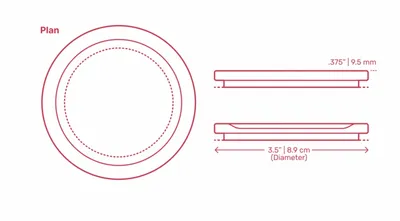
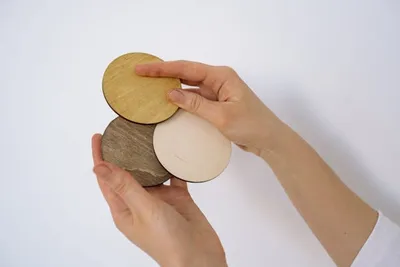
Woodworking coasters are small wood blanks cut, shaped, sanded and finished to protect a table from condensation and everyday drinkware. They can be made from solid hardwood, laminated scraps, plywood, MDF or dry branch slices, usually about 4 inches across.
A basic project needs suitable wood, a saw, sandpaper or a random-orbit sander, and a finish. Depending on the design, you may also use a router, wood glue, clamps or a laser cutter. The easiest version is a solid square or round blank with softened edges. Laminated, engraved and laser-cut versions add steps but make personalization easier. Skill level is novice with a saw already comfortable with push blocks and jigs, since 4 inch blanks are too small for freehand routing.
How Can Wooden Drink Coaster Plans Help You Choose A Design?
A useful wooden drink coaster plan gives the finished dimensions, stock thickness, cut sequence and required tools before you start. A more detailed modern coaster plan may also include glue-up dimensions, routing information and finishing steps.
Choose the plan around the equipment you actually have. A square coaster cut from flat hardwood needs little more than safe saw work and sanding. An inlaid or laminated design needs accurate ripping, clamping and flattening. A laser plan needs a machine-compatible vector file and test cuts.
What Is The Best Wood To Use For Coasters?
Dry, flat hardwood is the most forgiving choice for a long-lasting coaster. Maple gives a pale, closed-grain surface. Walnut offers a darker color. Cherry develops a warm tone. Oak gives pronounced grain but has more open pores that hold water unless the grain is filled.
The USDA Forest Products Laboratory reports side hardness at 12% moisture content of about 6,400 N for sugar maple, 6,000 N for white oak, 5,700 N for northern red oak, 4,500 N for black walnut and 4,200 N for black cherry. Hardness is useful for comparing dent resistance, but it does not tell you how well a coaster will resist water on its own.
| Species | Side hardness (N) | Pores | Color | Best for |
|---|---|---|---|---|
| Sugar maple | 6,400 | Closed | Pale, uniform | Daily bar use, engraved sets |
| White oak | 6,000 | Open, tyloses | Warm brown | Filled-grain, laminated panels |
| Northern red oak | 5,700 | Open | Reddish | Painted or laminated, not oil finish |
| Black walnut | 4,500 | Semi-open | Dark chocolate | Handsome gifts, forgiving of marks |
| Black cherry | 4,200 | Closed | Warm red-brown | Smooth 220-grit finish, glassware |
Research on wood surface roughness and coating adhesion also shows that species, surface structure, wettability and coating behavior interact. In a 2023 study of six species, bonding quality for a water-based acrylic coating varied with wood anatomy. Test the finish on the wood you are actually using rather than assuming every hardwood accepts the same coating equally.
What Is The Recommended Thickness And Size For Wood Coasters?
Want durable wood coasters for a bar or gift set?
Work with us to make custom wood coasters engraved or UV printed with your names, logos or artwork, ready for daily use.
How Can You Make Homemade Wooden Coasters?
Make the entire set from one prepared board or panel where possible. That keeps thickness, grain and color consistent. On the walnut blanks we deboss, we've found a 1 inch test cut is the first thing our operator runs on any new sheet, because kerf moves between batches.
The finishing calendar drives the total project time. Two coats of hardwax oil is a weekend project. Three coats of polyurethane on all six faces of eight coasters is closer to five days of patience while the finish cures. Cutting is an hour, sanding takes longer than you expect, and finishing takes days because dry is not the same as cured.
How Do You Cut, Shape And Sand Wooden Coasters?
Uniformity matters more than a complicated edge profile. Use a fence, stop block or jig so every blank finishes at the same size:
- Select flat, dry stock without loose knots or active cracks.
- Mark the finished dimensions and allow extra material for trimming.
- Cut all blanks using safe workholding and the appropriate saw.
- Ease sharp edges with a small roundover, chamfer or careful sanding.
- Sand the faces and edges progressively (120, 180, 220) until machining marks disappear.
- Remove sanding dust from every surface with a tack cloth.
- Test cutting and routing settings on scrap first.
A progression through 120, 180 and 220 grit removes saw marks without an abrupt jump. Stop earlier if the finish manufacturer specifies a different preparation. Small coaster blanks can be awkward to hold, so use appropriate workholding rather than bringing fingers close to a cutter.
Choose walnut coasters for a warm, handmade look
Our custom handmade walnut coasters come debossed or UV printed at 5 mm thickness, in 4 and 4.5 inch sizes.
Learn moreWhat Should You Seal Wooden Coasters With?
Choose the finish according to the condensation the coaster will see and the look you want. Oil finishes look right and repair easily but let water in. Film finishes resist water. Two-part epoxy shrugs off spills but adds bar-top thickness.
The USDA Wood Handbook notes that drying oils such as linseed and tung oil are appropriate for interior items "not subjected to water or high humidity", which matters because condensation is the normal operating condition for a coaster. FPL research on wood finishes and moisture found that penetrating finishes offered some protection from liquid water but comparatively little protection from water vapor, while coating performance varied by system. The mechanism is directly relevant: the type of finish changes how much moisture reaches the wood.
| Finish approach | Moisture protection | Appearance | Maintenance | Best fit |
|---|---|---|---|---|
| Drying oil alone | Limited for repeated wet use | Natural, low-build | Easy to refresh | Decorative or dry use |
| Hardwax-oil system | Product-dependent | Natural, tactile | Often repairable | Light to moderate use |
| Polyurethane film | Higher barrier potential | Clear film, several sheens | Harder to repair locally | Everyday drink coasters |
| Lacquer-type film | Thin film, fast application | Clear, smooth | Depends on formulation | Repeated indoor use |
| Epoxy coating | Thick barrier when correctly cured | Deep gloss | Harder to repair invisibly | Heavy-use surfaces |
We've seen the wood coaster we're sent most often for a reprint has a perfect top and a bare, swollen underside; nobody sealed face six. Seal every face.
How Should You Finish Wood For Coasters?
Remove sanding dust and apply the finish in the conditions stated on its label. Coat the faces, edges and any exposed end grain that can encounter moisture. If the product tells you to sand between coats, use the recommended grit and remove the resulting dust before recoating.
Do not treat "dry" and "fully cured" as the same point. Wait for the full cure specified by the finish manufacturer before regular use. Moisture entering wood causes dimensional movement and stresses the wood-coating interface; research on coating failures has found end grain especially vulnerable because it provides an efficient path for water entry. See our best finish for wood coasters guide for finish-specific depth.
How Can You Make Diy Branch And Wood-Slice Coasters?
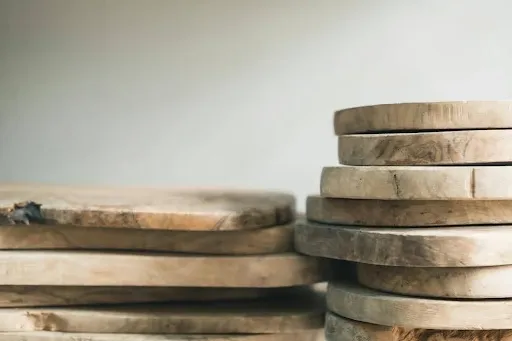
Start with sound, dry wood rather than freshly cut green branches. Cut slices as uniformly as your equipment allows, then let questionable pieces stabilize before spending time finishing them. Pick straight, sound branches at least 4 inches across, and cut them into 1/2 inch slices on the miter saw. A slice sealed at 20% moisture content will crack the first cold night.
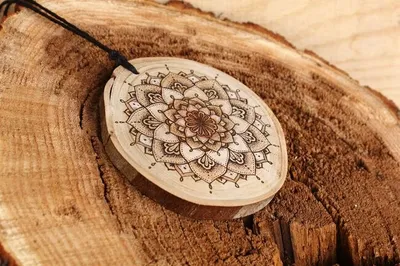
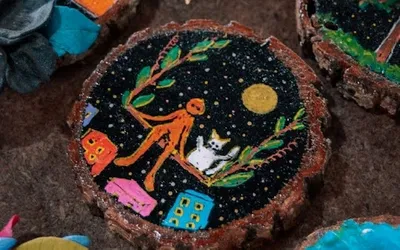
End-grain slices show growth rings and natural irregularities that are difficult to reproduce in milled lumber. Small checks, bark and shape variation can be part of the design, but loose bark and active cracks should be dealt with before finishing. Fill hairline checks with clear epoxy and a colored filler; stabilize wobbly bark with cyanoacrylate glue; remove it entirely if it is shedding.
How Do You Prevent Wood-Slice Coasters From Cracking Or Rotting?
You cannot guarantee a natural slice will never crack because wood continues to respond to humidity. Start with dry material, avoid excessively thin slices, and protect all exposed surfaces from repeated wetting. For indoor woodworking, the Forest Products Laboratory has long used roughly 6 to 8% moisture content as a target for furniture under typical dry indoor conditions, although the correct equilibrium moisture content depends on the environment where the finished piece will live.
Need large quantities of wood coasters for an event?
Order custom wood coasters in bulk for weddings, restaurants and corporate gifts, with generous wholesale discounts and a free proof.
How Can You Make Scrap Wood Coasters?
Scrap hardwood is ideal when the offcuts are dry, flat and large enough to machine safely. Sort pieces by thickness first, then by species, grain and color.
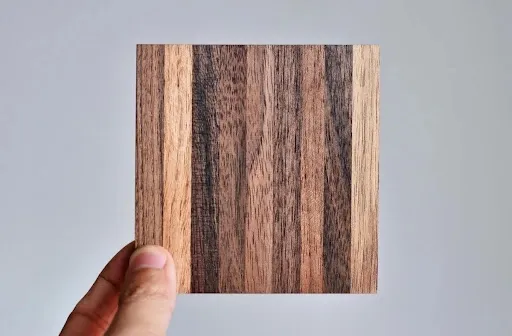
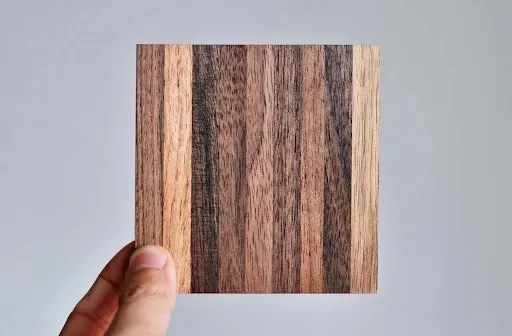
The simplest scrap set uses one species. A striped or cutting-board-style set uses several contrasting woods edge-glued into one panel, then flattened and crosscut. For yield planning, a 24-inch panel cut into 3.75-inch coasters with an assumed 1/8-inch kerf gives six full pieces before end-trim losses: panel length equals (coaster length plus kerf) times quantity plus a trimming allowance. Measure your own saw kerf rather than treating 1/8 inch as universal. Our pallet coasters guide walks through a similar scrap-to-set build.
How Can You Make Striped Wooden Coasters From Scrap Wood?
Rip safe, usable scraps into straight strips, arrange the colors, and edge-glue them into a panel. Use even clamping pressure and allow the adhesive to cure according to its instructions.
Flatten the panel before crosscutting individual coasters. If strips vary in height, sanding each finished coaster separately wastes time and can leave a set with inconsistent thicknesses. Keep grain direction and color order intentional. Repeating the same strip sequence across each coaster is the simplest way to make scraps look designed.
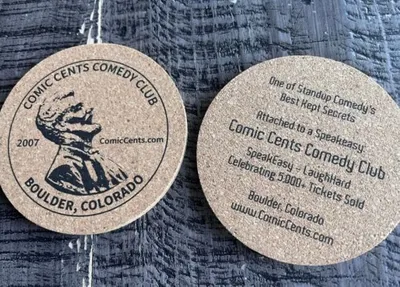
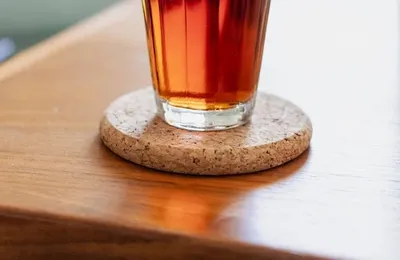
Print any design onto natural cork coasters
Cork keeps its warm, tactile look while accepting full-color printing, so you can match your bar or wedding palette on any budget.
Get startedHow Can You Create Custom Wooden Coaster Designs?
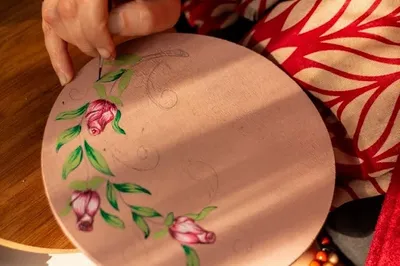
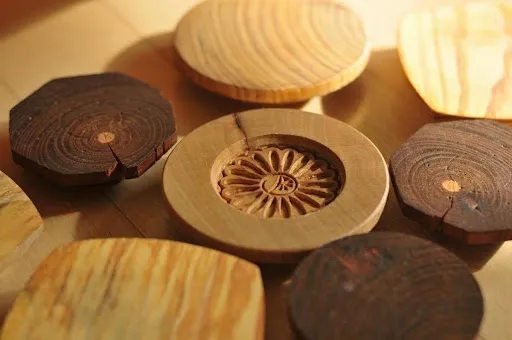
Shape, grain orientation, engraving, inlay and contrasting wood can all personalize a coaster without reducing the usable drinking surface. Book-matched flitches give a mirror image, and quarter-sawn oak flashes ray-fleck streaks that engraving cannot add. Plan decoration around the glass footprint. Deep carving or open cutouts beneath a cold glass can trap liquid or reduce stability, so keep the central contact area practical.
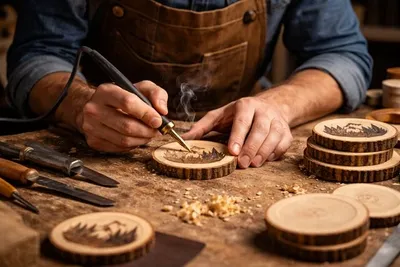
Manual techniques work well for one-off gifts. Digital engraving and laser cutting make repeatable names, monograms and geometric artwork easier when you need identical pieces. Keep decoration inside the drinking surface by 3/8 inch, so a wet glass does not sit on a fine engraved line that traps water.
What Woodworking Coaster Ideas Work Best For Personalized Sets?
Monograms, dates, simple line art, geometric patterns and repeating natural motifs reproduce well across a set. Consistent dimensions and one shared visual rule matter more than making every coaster identical. One coaster 1/16 inch thicker than the others reads as a mistake. Match the wood species, finish and decoration to the recipient.
Custom Coasters Now (customcoastersnow.com) prints and debosses walnut, bamboo and pallet coasters to order in 4 and 4.5 inch sizes, 5 mm thick, with a free proof and a 50-piece minimum. At small counts, hand-making is right; at 50 pieces the arithmetic (time per piece times count) flips toward a printed set from our custom handmade walnut coaster page.
How Can You Make Laser-Cut Wooden Coasters?
Laser cutting is useful for detailed repeatable outlines, scoring and engraving, but the machine, material and ventilation system control what is safe to process. Use only materials approved for the specific machine.
How Do Laser-Cut Coaster Plans And Files Work?
Laser plans usually use vector paths for cutting and scoring, with vector or raster artwork for engraving depending on the machine workflow. SVG, PDF, DXF and AI files are common, but compatibility depends on the laser software.
Run a small calibration cut before a full sheet. Material thickness, density, power, speed and focus can all change the result. A speed-and-power grid on a scrap of the same material, cleaned and labeled, saves an hour on the next batch. Check the file's license before commercial use; the downloadable artwork may be protected even when the basic method is not, and many free files are personal-use only.
Frequently Asked Questions About Woodworking Coasters
What Are Wooden Coasters Used For?
Wooden coasters give glasses and mugs a separate surface that can take condensation, minor spills and everyday handling instead of the table beneath them. A finished set can also add a repeated wood, color or personalized design to a table or bar.
Which Wood Is Best For Making Coasters?
Dry hardwoods such as maple, cherry and walnut are practical choices because they machine cleanly and take a smooth finish. Oak works too, but its more open grain influences the look and finishing process. The finish and moisture control matter as much as the species.