Star Coaster Crochet Pattern: How Can You Crochet A Beautiful Star-Shaped Coaster?
A good star coaster needs even points, a center that lies flat, and enough surface area for the intended glass or mug. Yarn weight, hook size and tension all change the result, even when two crocheters follow the same construction. We want your stars to land flat and even every time, so we made this guide to walk you through the method, sizing and blocking for a solid star coaster crochet pattern.

Key Takeaways
- Count the stitches or repeats that feed each point before finishing the round; one skipped stitch means one point smaller than the others.
- Cotton is a useful everyday coaster fiber because it absorbs more moisture into the fiber than polyester, though fabric construction also affects wicking.
- Hook size and tension alter loop length, dimensions and curling; gauge matters when you want several stars to finish at the same size.
- We supply high-quality custom embroidered cotton and linen coasters and die-cut star-shaped coasters, with a free proof and a 50-piece minimum.
Table of contents
-
What Is The Star Coaster Crochet Pattern?
-
Is There A Free Crochet Pattern For A Coaster?
-
What Materials Do You Need For Crocheted Star Coasters?
-
How Do You Crochet A Star Coaster Step By Step?
-
What Is The Easiest Crochet Star Pattern For Beginners?
-
What Size Should A Crochet Star Coaster Be?
-
Does A Crochet Star Coaster Need Blocking?
-
What Variations Can You Make From A Star Crochet Coaster Pattern?
What Is The Star Coaster Crochet Pattern?
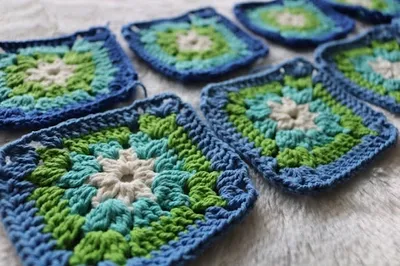
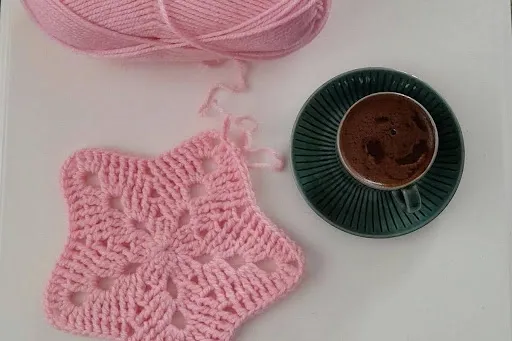
A star coaster crochet pattern gives instructions for making a flat star-shaped motif large enough to sit beneath drinkware. Most versions begin at the center, expand in rounds, then shape repeated points around the outside.
The same motif can become a coaster, Christmas decoration, appliqué, garland element or gift tag by changing its size and finishing. A beginner should choose a pattern with complete materials, abbreviations, stitch counts and finished dimensions. Five-point designs are easiest to check because every point should use the same shaping logic. We've found the star coasters we've been sent to reproduce as embroidery all had the same flaw: two points longer than three, from a miscounted round.
Is There A Free Crochet Pattern For A Coaster?
Yes. Crochet blogs, yarn-company pattern libraries and independent designers publish free coaster patterns. Some are complete web pages with advertising, while paid downloads often provide cleaner printable formatting, extra sizes or more detailed photographs.
Before starting, check the stated terminology, hook size, yarn weight, finished size and usage terms. Free does not mean unrestricted. US copyright law generally does not protect a procedure or simple set of directions as such, although original written explanations, photographs and artwork can be protected. The US Copyright Office's Circular 33 confirms that copyright excludes any procedure or method. Respect the designer's stated terms when downloading or using a pattern. Many designers explicitly permit selling finished items from their free patterns; others restrict use to personal projects. When the terms are unclear, ask before selling.
Where Can You Find Free Star Coaster Crochet Instructions?
Look for a pattern that gives more than a finished photograph. Useful instructions identify yarn weight, hook size, abbreviations, round or row structure, stitch counts and finishing steps.
Established yarn companies and experienced designers often use standardized terminology. Save the instructions or print a permitted copy before starting so the pattern remains available while you work. Do not mix rounds from different star patterns unless you understand how their stitch counts and point shaping connect. Our easy crochet coasters guide collects other motifs and construction pointers for beginners.
Want star-shaped coasters without the crochet hooks?
Work with us to make custom-shaped star coasters printed with your artwork, in cotton and linen, felt or fabric, ready for weddings and holidays.
What Materials Do You Need For Crocheted Star Coasters?
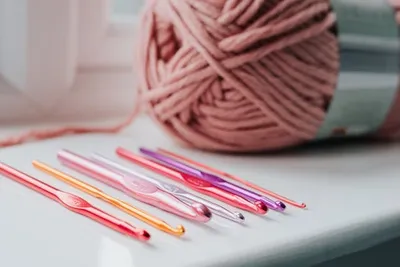
For a basic set, you need yarn, an appropriately sized crochet hook, scissors and a yarn needle. Stitch markers help when the beginning of the round is hard to see, and a single locking marker at the start of each round is enough for a five-point star.
Blocking mats and rust-resistant pins are optional. A non-slip backing can help on polished surfaces if it does not make the coaster difficult to wash. Changing yarn thickness or hook size changes both the fabric thickness and the star's finished dimensions, so record what you use for the first coaster before making the rest. Yardage estimates help too. About 20 yards of worsted cotton typically covers one star, so a 120-yard ball makes five or six coasters.
What Is The Best Yarn For A Crochet Star Coaster?
Cotton is a practical starting choice for a functional coaster because it is washable and can take up more moisture into the fiber than polyester. A 2021 textile study on cotton and polyester moisture behavior measured about 4.9% moisture content for untreated cotton versus about 0.5% for untreated polyester at 65% relative humidity. The experiment compared fabrics rather than crochet coasters, so the figures should be read as fiber behavior, not coaster performance.
Choose embroidered cotton coasters for a handmade feel
Our cotton and linen embroidered coasters carry the warmth of stitched fabric with the precision only a factory embroidery machine gives.
Learn moreHow Do You Crochet A Star Coaster Step By Step?
The construction is a center-out method followed by repeated point shaping.
- Begin with a magic ring or the foundation method specified by your pattern.
- Work the first round evenly into the center.
- Add increases over the next rounds so the center stays flat.
- Count the stitches available for the outer points.
- Divide them into equal groups for a five-point star.
- Work the same point sequence over each group, checking the count before moving on.
- Join or finish the final round as the pattern directs.
- Fasten off, weave in the ends and block only if the shape needs correction.
If the center cups upward, you may have too few increases, very tight tension or a hook that produces shorter loops than the designer's sample. Rip back to the first round where the shape stopped lying flat rather than trying to force severe distortion out during blocking.This beginner-friendly pattern makes a five-point star coaster in three short rounds.
Materials
- Worsted-weight cotton yarn
- 4 mm crochet hook
- Yarn needle
- Scissors
- Stitch marker
US abbreviations: ch = chain, sl st = slip stitch, sc = single crochet, hdc = half double crochet, dc = double crochet, st(s) = stitch(es)
Finished size: Approximately 4–5 inches tip to tip, depending on the yarn, hook, and tension.
Round 1: Make a magic ring. Ch 1. Work 10 hdc into the ring. Pull the ring closed. Join with a sl st to the first hdc. (10 sts)
Round 2: Ch 1. Work 2 hdc into each stitch around. Join with a sl st to the first hdc. (20 sts)
Round 3: Ch 1. Repeat the following sequence five times:
Sc in the next st. Hdc in the next st. Work (2 dc, ch 2, 2 dc) in the next st. Hdc in the next st.
Join with a sl st to the first sc. You should now have five points. One ch-2 space forms the tip of each point.
Fasten off. Weave in the yarn ends securely. Wet-block the coaster. Gently shape all five points to equal lengths. Let it dry flat before use.
Before making a full set: Crochet one sample. Wash it. Confirm that the finished coaster lies flat, supports the base of your drinkware, and retains its shape after drying.
How Do You Form The Center And Even Star Points?
The center must distribute the increases evenly before the points begin. A star with an uneven foundation often ends with two long points and three short ones, even if the final shaping sequence is repeated correctly.
Mark the first stitch or repeat. Count the total before dividing the round into five equal point sections. Research on crochet tension, hook size and curling found that greater yarn tension shortened loop length and increased curling, while a thicker crochet hook increased loop length and reduced curvature in the fabric tested. It is not a star-coaster trial, but it explains why changing tension or hook diameter changes whether a flat motif behaves as expected.
For the point sequence itself, a common approach uses a graduated stitch pattern: single crochet at the base, half-double and double crochet as the row moves toward the tip, then a small chain at the peak to sharpen it, and the mirror sequence back down. Every point should use the same graduation, or the star reads uneven at a glance.
What Is The Easiest Crochet Star Pattern For Beginners?
A simple flat star worked from the center outward is easier to troubleshoot than a heavily textured or multi-layered motif. Look for repeated points and a short list of basic stitches. You should be comfortable with chains, slip stitches, single crochet, half double crochet or double crochet, working in rounds and following a repeated sequence.
A "star stitch" is a textured crochet stitch. It does not automatically create a star-shaped coaster. For a first set, use one yarn color. Add color changes after you know the pattern lies flat. Work with us on custom shaped coasters if a die-cut star in fabric or felt fits your event better than a crocheted one.
Which US Crochet Abbreviations Should You Understand?
Common US abbreviations include ch (chain), sl st (slip stitch), sc (single crochet), hdc (half double crochet), dc (double crochet), st or sts (stitch or stitches), and rep (repeat).
The Craft Yarn Council confirms that its crochet abbreviation list reflects US terminology. It also notes important US and UK differences: US single crochet corresponds to UK double crochet, while US double crochet corresponds to UK treble. Keep the pattern's abbreviation key visible until the repeats become familiar.
Need holiday coasters for a Christmas gathering?
Order custom personalized Christmas coasters featuring stars, snowflakes or family names, and skip the yarn calendar entirely.
What Size Should A Crochet Star Coaster Be?
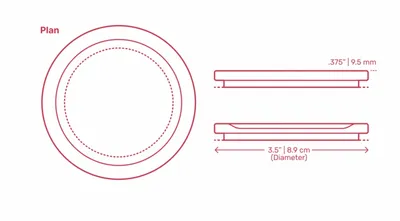
A practical drink coaster often finishes somewhere around 3.5 to 5 inches across, but the correct size is the one that supports your glass or mug without the drink sitting directly on the star tips. Measure the finished star from the tip of one point across the center to the farthest opposite edge or point.
| Yarn setup | Starting hook range | Likely use |
|---|---|---|
| DK or light worsted | About 4 to 5.5 mm | Smaller glasses and decorative stars |
| Medium or worsted | About 5.5 to 6.5 mm | Everyday drink coasters |
| Worsted held double or bulky | Larger hook matched to yarn | Oversized mugs or decorative stars |
The Craft Yarn Council publishes hook ranges by yarn-weight category but calls them guidelines only. Gauge in the actual pattern should control your choice. The table above is sizing guidance, not a substitute for a pattern gauge.
Why Do Finished Size And Gauge Matter?
Gauge tells you how large a given number of stitches becomes in your hands. The same yarn and pattern can finish differently when one crocheter holds the yarn more tightly than another.
A 2023 study of hand-crocheted fabrics found meaningful differences in dimensions and mechanical properties between crocheters, while work made by the same person was sufficiently reproducible for testing. That reinforces a practical rule for sets: make one coaster, measure it, then keep the yarn, hook and tension approach consistent for the rest. If the star is too small and dense, try the pattern's next permitted hook size. If it is too large and loose, move down only after checking that the fabric still lies flat.
Print any design onto durable felt coasters
Felt coasters take color beautifully and feel closer to a hand-crocheted set than plastic, with generous bulk discounts on larger orders.
Get startedDoes A Crochet Star Coaster Need Blocking?
Blocking is useful when the center is basically correct but the points need sharpening or minor waves need relaxing. It should refine the shape, not rescue a badly miscounted round.
For washable cotton, wet blocking is straightforward when the yarn label permits it. Shape the damp star to its intended dimensions and let it dry flat. For synthetic fibers, follow the yarn maker's temperature guidance. High heat can alter synthetic textiles, so do not press a hot iron directly onto an acrylic coaster. The Canadian Conservation Institute notes that manufactured fibers differ substantially in their response to environmental conditions and heat.
How Do You Stiffen A Crochet Coaster?
A functional drink coaster usually benefits from flexibility and washability more than rigid stiffness. Block it first.
Fabric stiffener, starch and glue-based treatments are more useful when the star will be an ornament or decoration. They can alter absorbency, hand and washability. Test any stiffening product on a yarn sample before treating the finished project, especially when the star contains multiple colors. Store finished stars are flat and fully dry; damp yarn stored folded can encourage mildew, and stains from stored moisture rarely wash out later.
What Variations Can You Make From A Star Crochet Coaster Pattern?
Once the base motif works, vary color before changing the structure. Solid sets, contrasting borders, narrow stripes and variegated yarn preserve the construction while changing the look.
Can One Star Design Become A Coaster, Ornament Or Doily?
Yes, but function should control the material and scale. A coaster needs enough density and area to support drinkware. An ornament can use finer yarn and stiffening because nothing rests on it. A doily can use lighter thread, a larger motif and more open spaces because its job is decoration and not water absorption.
Changing yarn weight, hook size or the number of rounds changes dimensions. A DK cotton at a 3.75 mm hook can produce a small ornament star, while a bulky yarn at a 6.5 mm hook produces an oversized decorative version. Once you alter those variables substantially, make a new sample instead of assuming the coaster measurements still apply. On the fabric side, our custom felt coasters deliver a similar warmth in a die-cut form.
Frequently Asked Questions About Star Coaster Crochet Pattern
What Is A Star Coaster Crochet Pattern?
A star coaster crochet pattern is a set of instructions for crocheting a flat, five-point star-shaped motif sized to sit beneath a glass or mug. Most versions build a center in rounds and then repeat the same shaping sequence to form evenly spaced points, finishing near 3.5 to 5 inches across.
Where Can You Find A Free Crochet Pattern For A Coaster?
Free crochet coaster patterns are available from yarn-company libraries, crochet designers and craft websites such as Ravelry. Check that the pattern gives terminology, yarn weight, hook size, stitch counts, finished dimensions and usage terms before starting a set.